

You have liked a home, the price seems acceptable and the seller assures you that other buyers are interested too. In such a situation, the suggestion to leave a deposit the very same day can sound perfectly logical. It is precisely then, however, that some of the costliest mistakes in buying real estate are made.
A deposit is not just a sign that your intentions are serious. Depending on the document signed and the clauses used, it can lead to specific financial obligations, limited options to withdraw and a dispute over the return of the sum. That is why, before you transfer money or sign a reservation document, you need to know who is selling the property, what rights they hold, whether there are registered encumbrances and whether the home in the documents matches what you saw at the viewing.
The checks that follow do not replace an individual consultation with a lawyer, but they provide a clear framework for the questions that must be clarified before a deposit.
1Why the check must be done before payment

Many buyers assume that a detailed check of the documents is only done before the preliminary contract or the notarial deal. That may be too late if an amount has already been paid on unfavourable terms.
After paying a deposit, the buyer often finds themselves under pressure to continue with the deal, even when doubts arise later. The reason is the fear that the amount will not be refunded. If the document does not clearly state when the buyer may withdraw and under what circumstances the money is returned, any discrepancy can turn into a dispute.
Before paying, at least the following questions should be clarified:
- who owns the home and who has the right to sell it;
- whether there are mortgages, distraints, lawsuits or other registered rights;
- whether the address, area, identifier and designated use of the property match;
- who receives the deposit and on what grounds;
- under what conditions the amount is returned;
- what happens if the bank refuses financing;
- by when the seller is obliged to provide the necessary documents.
If you are only now organising the whole process, a useful starting point is the guide for people who are buying a property for the first time. This article looks more narrowly at the specific moment immediately before the deposit.
2Check who the owner of the home really is
The first step is not to negotiate the amount of the deposit, but to establish who owns the property. The name of the person conducting the viewing or negotiations is not sufficient proof of ownership.
Ask for a copy of the current ownership document. This could be a notarial deed, a contract, a court decision, an award order, an inheritance deed together with the preceding document, or another deed certifying the acquisition.
The following should be compared:
- the owner's names and identification details;
- the full description of the property;
- the basis on which it was acquired;
- the undivided shares of the land and common parts;
- the included cellar, attic, garage or parking space;
- any restrictions or reserved rights in rem.
One owner in the listing does not mean one owner on paper
The home may belong to more than one person. This occurs with inherited properties, marital community property, co-ownership between relatives or acquisition by partners.
A deposit should not be paid to only one of the co-owners without clarity on whether the others agree to the sale. Even when a person owns an undivided share, this does not automatically mean they can undertake to sell the entire property on behalf of everyone.
With an inherited home, you need to establish who all the heirs are and whether there is a person not taking part in the negotiations. It is necessary to review the certificate of heirs, the deceased's ownership documents and any subsequent transactions between the heirs.
Check marital status and the way it was acquired
A property registered in only one spouse's name cannot always be sold with only that spouse's involvement. The date, the manner of acquisition and the applicable property regime all matter.
It is not enough to look only at the name in the notarial deed. You need to establish whether the property was acquired during the marriage, through inheritance, gift, a purchase with personal assets, or under another regime. This is a question that should be checked by a specialist based on the specific documents.
3Check for encumbrances and registered rights
The Property Register contains information on deeds relating to ownership and other rights in rem, as well as registered mortgages and attachments. It can be used to run searches on ownership, owners, rights and restrictions on real estate.
The property certificate reflects the entries, notations and deletions of encumbrances and rights as of the time it was prepared, or certifies that there are none. Issuing it requires details of the property, a copy of the ownership deed and a current cadastral plan or sketch.
Among the circumstances that can be established by the check are:
- a contractual or statutory mortgage;
- an attachment;
- a registered claim;
- a right of use;
- a right to build;
- contracts and deeds affecting ownership;
- other rights or restrictions depending on the specific case.
It is important for the check to cover not only the current owner but the whole relevant ownership history. A formally clean certificate issued for an insufficient period or on incomplete data is not always enough for a complete legal assessment.
A mortgage does not necessarily mean the property cannot be bought
A home with a mortgage can be the subject of a transaction, but the method of payment and of discharging the mortgage must be carefully organised.
Do not rely only on a verbal promise that the seller will repay the loan after receiving the price. There must be a clear procedure, agreed with the lending bank, which specifies:
- the exact amount of the debt;
- the account to which payment must be made;
- the conditions for issuing consent to the mortgage's discharge;
- the deadline for discharging the mortgage;
- how the remainder of the purchase price is paid.
In such a transaction, paying a deposit without a mechanism clarified in advance increases the risk for the buyer.
4Compare the notarial deed with the cadastral plan

After checking ownership, you need to establish whether the property in the documents is the same property that is actually being offered.
Request an up-to-date plan of the individual unit from the cadastre, where an approved cadastral map exists for the area. Compare the cadastral identifier, the address, the floor, the area, the designated use and the ancillary premises with the notarial deed.
The following discrepancies require particular attention:
- an apartment described with a different area in different documents;
- an enclosed terrace that does not appear in the documents;
- walls that have been moved or removed;
- merged rooms or a divided apartment;
- an attic or cellar used as living space;
- a unit with the status of an atelier, surgery or other non-residential property advertised as an apartment;
- a parking space offered as separate property without the documents confirming this.
A difference between the actual condition and the official documents can complicate bank lending, future renovation, resale or an administrative procedure. That is why phrases such as “everyone has done it” and “it doesn't matter” should not replace a documentary check.
5Be careful when the seller acts through a proxy
A sale through a proxy is permitted, but it carries additional risks. Before paying a deposit, the original power of attorney, its scope and whether it is still valid must be checked.
The power of attorney must clearly show whether the representative has the right to:
- negotiate the sale price;
- sign a reservation or preliminary agreement;
- receive a deposit and other payments;
- sign the notarial deed;
- represent the owner before a bank, notary and institutions.
The fact that a person can show the property does not mean they have the right to receive money on the owner's behalf.
It is sensible to establish direct contact with the owner and confirm that the sale is genuinely taking place with their knowledge. If there are doubts about the authenticity, revocation or termination of the power of attorney, payment should be postponed until the check is complete.
6Tell apart “deposit”, “earnest money” and reservation fee
In everyday speech, different payments are often called simply a “deposit”. Their legal effect, however, depends less on the title of the document than on the content of the agreement.
The amount may be defined as:
- an advance payment towards the future sale price;
- earnest money securing performance;
- a reservation fee;
- a fee under a brokerage agreement;
- a security deposit held until certain conditions are met.
So do not sign a document just because it is titled “deposit protocol”. Read exactly what happens to the amount if the seller backs out, the buyer backs out, an encumbrance is found, a document is missing or the bank refuses to grant a loan.
What the deposit document should say
Before paying, the document must unambiguously identify the parties and the property. It is best if it contains at least:
- the exact amount and method of payment;
- the grounds for its receipt;
- the sale price of the property;
- the period for which the property is taken off the market;
- the deadline for submitting the documents;
- the final deadline for signing a preliminary agreement;
- the conditions for returning or retaining the amount;
- the consequences of withdrawal or non-performance by either party;
- an express condition for a legal check;
- a bank financing condition, when the purchase is made with a loan.
The amount should be paid in a traceable way and to a person who has the right to receive it. The reference in the bank transfer must match the signed document.
7Do not treat bank approval as a formality
The buyer's pre-approval and the approval of the specific property are different stages. Even if you have an indicative opinion from a bank, the specific home may not be accepted as security or may be valued lower.
If the deal depends on a mortgage, the deposit document must regulate what happens in the event of:
- the bank refusing to finance the specific property;
- an insufficient market valuation;
- documentary discrepancies found;
- a delay not caused by the buyer;
- the seller being unable to provide the required documents.
It is useful to get advice on the options for a mortgage even before active negotiations. This does not remove the need for a financing condition in the contract, but it reduces the risk of reserving a property you cannot acquire on the planned terms.
8Additional checks for new construction
For a home under construction, the check does not stop at the ownership of a specific apartment, because the unit may not yet exist as an independent property in finished form.
You need to analyse ownership of the land, the building right, the building permit, the approved designs, the participants in the project and the company's right to sell the specific unit.
The following must be clear:
- the exact area and layout;
- the ancillary parts;
- the degree of completion;
- the deadlines for the individual construction stages;
- the payment schedule;
- the penalties for delay;
- the permitted changes to the design;
- the conditions for the final transfer.
The topic is covered in detail in the separate checklist for safely buying an off-plan property, so here the emphasis stays on the decision of whether to pay a reservation sum at all.
9Red flags that call for slowing down
Some situations do not necessarily mean fraud or an impossible deal, but they require you to stop and check further:
- refusal to provide an ownership document;
- insistence on cash payment without a detailed document;
- a deposit to a person who is not the owner or an authorised recipient;
- a claim that encumbrances will be checked “at the end”;
- an unexplained discrepancy between the area in the listing and in the documents;
- a missing co-owner or heir;
- a sale through a proxy with no contact with the owner;
- too short a deadline for signing;
- a clause under which the amount is kept for almost any reason for withdrawal;
- a promise that an unlawful conversion will easily be legalised;
- unwillingness to put the terms in writing.
Pressure that “two more people will put down a deposit today” is no reason to skip the checks. A good offer does not become safe just because it is in demand.
10Practical order of steps before a deposit
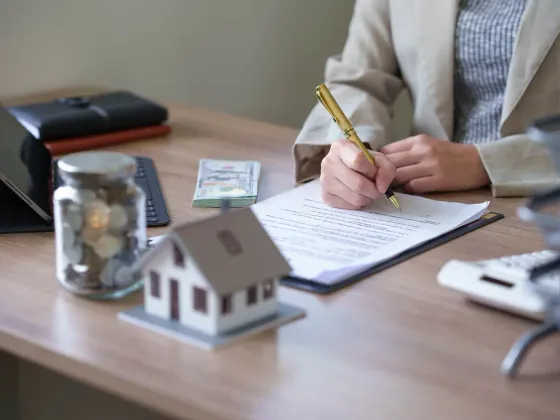
To reduce the risk, organise the process step by step:
- Ask for the main ownership and identification documents for the property.
- Establish all the owners and the persons who must take part in the transaction.
- Check the ownership and registered encumbrances.
- Compare the notarial deed, the cadastral plan and the actual condition.
- Clarify the status of alterations, ancillary rooms and parking spaces.
- Check the authority to represent, if an attorney is involved.
- Agree the terms with the bank when the purchase involves a loan.
- Agree in writing when the deposit is returned.
- Pay only in a traceable way and against a signed document.
- Keep all documents, correspondence and proof of payment.
A professional real estate agent can coordinate communication, document gathering and the various participants in the process. The independent legal assessment, however, must be carried out by a qualified lawyer, especially in cases of inheritance, mortgage, power of attorney, new construction or documentary discrepancies.
11A safe purchase starts before the first transfer
The deposit should follow from sufficient clarity, not be a way of buying yourself time to check afterwards. Before paying, you need to know what property you are buying, who you are buying it from, whether there are any restrictions and under what circumstances you can get the money back.
Neither a good location nor an attractive price makes up for unclear ownership or an unfavourable contract. When the documents have been checked, the terms are written down specifically and the payment is traceable, the deposit serves its true purpose – to prepare the next stage of the deal safely, instead of becoming a source of risk.
Comments
There are no comments yet. Be the first to share what you think about the article.